

One of the most common methods used to detect exoplanets is the transit method. This method involves observing a star and looking for periodic dips in its brightness. When a planet passes in front of its star, it blocks out a small portion of the star’s light, causing a temporary decrease in brightness. By carefully monitoring these dips in brightness, scientists can infer the presence of a planet and gather information about its size and orbit.
Another method used to detect exoplanets is the radial velocity method. This method relies on the fact that a star and its orbiting planet both exert a gravitational pull on each other. As a planet orbits its star, it causes the star to wobble slightly, which can be detected as a shift in the star’s spectral lines. By measuring these shifts in the star’s velocity, scientists can determine the presence and characteristics of an exoplanet.
In recent years, the field of exoplanet research has seen numerous exciting discoveries. One notable example is the discovery of the TRAPPIST-1 system, which is located about 40 light-years away from Earth. This system is home to seven Earth-sized planets, three of which are located within the star’s habitable zone. The discovery of these potentially habitable planets has sparked great interest among scientists and the public, as they raise the possibility of finding extraterrestrial life.
Another intriguing discovery is the exoplanet known as HD 189733b. This planet, located about 63 light-years away, has a deep blue color due to the presence of a hazy atmosphere containing tiny particles of silicate and aluminum oxide. This discovery challenges our preconceived notions of what an exoplanet might look like and highlights the incredible diversity that exists in the universe.
As our techniques for detecting exoplanets continue to improve, we can expect to uncover even more fascinating discoveries. The study of exoplanets allows us to expand our understanding of the universe and explore the possibility of life beyond our own planet. By studying the characteristics of exoplanets, scientists can gather valuable insights into the formation and evolution of planetary systems, as well as the potential for habitability in other parts of the cosmos.
Methods of Exoplanet Detection
Over the years, astronomers have developed several methods to detect exoplanets. Each method has its own strengths and limitations, and scientists often use a combination of techniques to confirm the existence of a planet.
1. Transit Method
The transit method is one of the most widely used techniques for detecting exoplanets. It involves observing the slight dimming of a star’s brightness when a planet passes in front of it. By measuring the periodic dips in brightness, astronomers can determine the size, orbital period, and distance of the planet from its star.
This method has been highly successful in identifying thousands of exoplanets, including some that are similar in size and composition to Earth. One notable discovery made using the transit method is the Kepler-452b, which is often referred to as Earth’s “cousin” due to its similarities in size and orbit.
However, the transit method does have some limitations. It is biased towards detecting exoplanets that are aligned in such a way that they transit their stars from our vantage point. This means that the transit method is more likely to detect exoplanets with short orbital periods and those that are larger in size. Additionally, the transit method cannot provide information about the planet’s atmosphere or composition.
2. Radial Velocity Method
The radial velocity method, also known as the Doppler method, relies on the detection of small shifts in a star’s spectrum caused by the gravitational pull of an orbiting planet. As a planet orbits its star, it exerts a gravitational tug, causing the star to wobble. This wobble can be detected by measuring the changes in the star’s radial velocity.
This method is particularly effective in detecting massive exoplanets that are close to their parent stars. It has been instrumental in the discovery of many “hot Jupiters,” gas giants that orbit very close to their stars. The radial velocity method has also been used to find the first exoplanet in the habitable zone of a star, such as Proxima Centauri b.
However, the radial velocity method also has limitations. It is more challenging to detect smaller exoplanets using this method, as the gravitational tug they exert on their star is less pronounced. Additionally, the radial velocity method can only provide information about the minimum mass of the planet, not its actual size or composition.
3. Direct Imaging
Direct imaging involves capturing the actual light emitted or reflected by an exoplanet. This method is extremely challenging because the light from the planet is often overwhelmed by the brightness of its parent star. However, advances in technology have made it possible to directly image some exoplanets.
Direct imaging is particularly useful for studying young, massive exoplanets that are far away from their stars. It allows astronomers to analyze the planet’s atmosphere and composition, providing valuable insights into the formation and evolution of planetary systems. Notable examples of exoplanets imaged directly include HR 8799e and Beta Pictoris b.
Despite its advantages, direct imaging also has limitations. It is most effective for detecting large exoplanets that are far away from their stars, making it less suitable for finding Earth-like planets in the habitable zone. Additionally, direct imaging requires advanced telescopes and sophisticated techniques, making it more challenging and resource-intensive compared to other detection methods.
Recent Discoveries
Thanks to advancements in technology and the tireless efforts of astronomers, the number of known exoplanets has been steadily increasing. Here are some of the recent discoveries that have captured the attention of the scientific community:
1. TOI 700 d
In January 2020, NASA’s Transiting Exoplanet Survey Satellite (TESS) discovered a potentially habitable exoplanet called TOI 700 d. This Earth-sized planet orbits a small, cool M-dwarf star within the star’s habitable zone. Scientists believe that TOI 700 d has the potential to support liquid water, making it an exciting candidate in the search for extraterrestrial life.
TOI 700 d is located approximately 100 light-years away from Earth in the constellation Dorado. Its discovery was made possible by TESS, which uses the transit method to detect exoplanets. This method involves observing the slight dimming of a star’s light when a planet passes in front of it. By analyzing the patterns of these dimmings, astronomers can determine the presence and characteristics of exoplanets.
TOI 700 d has a radius that is about 1.2 times that of Earth, and it completes an orbit around its star every 37 days. It receives about 86% of the energy that Earth receives from the Sun, placing it within the star’s habitable zone. This means that TOI 700 d is at a distance from its star where conditions may be just right for the existence of liquid water, a key ingredient for life as we know it.

Further studies are underway to learn more about the atmosphere and composition of TOI 700 d. Scientists hope to determine if the planet has an atmosphere and whether it contains any signs of life, such as the presence of certain gases or chemical compounds.
2. TRAPPIST-1 System
In 2016, the TRAPPIST (Transiting Planets and Planetesimals Small Telescope) project made a groundbreaking discovery. They found a system of seven Earth-sized exoplanets orbiting a small, ultra-cool dwarf star called TRAPPIST-1. Three of these planets are located within the star’s habitable zone, making them potential candidates for hosting liquid water and, potentially, life.
The TRAPPIST-1 system is located approximately 39 light-years away from Earth in the constellation Aquarius. The discovery of this system was significant because it provided astronomers with an opportunity to study multiple potentially habitable exoplanets in one system. Observations of the TRAPPIST-1 planets have revealed that they have a range of sizes and compositions, with some being similar to Earth in terms of their density and potential for hosting liquid water.
TRAPPIST-1e, f, and g are the three planets within the habitable zone of the TRAPPIST-1 system. These planets receive similar amounts of energy from their star as Earth does from the Sun, making them promising targets in the search for life beyond our solar system. Scientists are using a variety of techniques, including atmospheric modeling and spectroscopy, to study the potential habitability of these planets and search for signs of life.
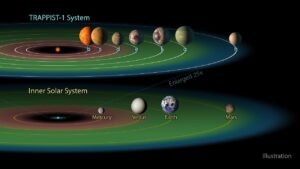
The TRAPPIST-1 system contains a total of seven known Earth-sized planets. Three of them — TRAPPIST-1e, f and g — are located in the habitable zone of the star (shown in green in this artist’s impression), where temperatures are just right for liquid water to exist on the surface. While TRAPPIST-1b, c and d are too close to their parent star and TRAPPIST-1h is too far away, the remaining three planets could have the right conditions to harbour life. As a comparison to the TRAPPIST-1 system the inner part of the Solar System and its habitable zone is shown.
3. Proxima Centauri b
In 2016, astronomers announced the discovery of Proxima Centauri b, an exoplanet orbiting the closest star to our solar system, Proxima Centauri. This rocky planet is slightly larger than Earth and orbits within the habitable zone of its star. Proxima Centauri b has sparked interest in the search for nearby exoplanets that may harbor conditions suitable for life.
Proxima Centauri b is located approximately 4.24 light-years away from Earth, making it the closest known exoplanet to us. Its proximity has made it an attractive target for further study and exploration. Scientists are particularly interested in understanding the planet’s atmosphere and whether it contains the necessary conditions for liquid water to exist on its surface.
Observations of Proxima Centauri b have indicated that it may be subject to intense stellar activity from its host star, which could have implications for its potential habitability. Stellar flares and radiation can impact the atmosphere and surface of a planet, potentially affecting its ability to support life. Further research is needed to determine the exact conditions and potential habitability of Proxima Centauri b.
These recent discoveries highlight the incredible diversity of exoplanets that exist beyond our solar system. Each new finding brings us closer to answering the age-old question of whether we are alone in the universe and expands our understanding of the potential for life beyond Earth.
