

Galaxies, the sprawling collections of stars, gas, and dust, are the building blocks of the universe. They are enormous structures that can contain billions or even trillions of stars, along with other celestial objects such as planets, asteroids, and comets. The existence of galaxies was first discovered in the early 20th century, and since then, astronomers have been studying them to unravel the mysteries of the cosmos.
There are different types of galaxies, each with its own unique characteristics. Spiral galaxies, like our very own Milky Way, have a distinct spiral shape, with a central bulge surrounded by long, winding arms. These arms are filled with young, hot stars, while the bulge contains older, cooler stars. Elliptical galaxies, on the other hand, have a more rounded shape and are composed mainly of older stars. Irregular galaxies, as the name suggests, don’t have a specific shape and are a mix of young and old stars.
Within these galaxies, stars are born, live out their lives, and eventually die. The process of star formation begins when a dense cloud of gas and dust collapses under its own gravity. As the cloud contracts, it heats up and forms a protostar, which is a hot, glowing ball of gas. Over time, the protostar continues to gather more material and grows in size, eventually becoming a full-fledged star.
Stars vary in size, with some being much larger and more massive than others. The smallest stars, known as red dwarfs, can be less than half the size of our Sun and have relatively low temperatures. On the other end of the spectrum, there are massive stars that are dozens or even hundreds of times more massive than the Sun. These massive stars burn through their fuel at a rapid pace and have relatively short lifetimes compared to smaller stars.
As stars age, they undergo various changes. Some stars, like our Sun, will eventually exhaust their nuclear fuel and become red giants. During this phase, the star expands and becomes much larger, engulfing any nearby planets. Ultimately, the star will shed its outer layers, leaving behind a dense core known as a white dwarf. Other stars, especially those with much larger masses, will end their lives in spectacular explosions called supernovae. These explosions release an enormous amount of energy and can briefly outshine an entire galaxy.
It is within these galaxies that the vast majority of stars reside, each playing a vital role in the cosmic ballet of the universe. They are not mere points of light in the sky but rather the engines that drive the evolution and dynamics of galaxies. By studying these stars and their galaxies, astronomers can gain insights into the formation of the universe, the life cycles of stars, and the processes that shape the cosmos as a whole.
The Importance of Galaxies in Star Formation
Star formation is a complex process that requires specific conditions to occur. One of the key ingredients for the birth of stars is dense clouds of gas and dust. These clouds act as nurseries, providing the necessary raw materials for the formation of new stars. Within galaxies, these dense clouds can be found in abundance, making them the ideal environments for star formation.
Galaxies are vast collections of stars, gas, and dust, held together by gravity. They come in different shapes and sizes, ranging from spiral galaxies like our own Milky Way to elliptical and irregular galaxies. Regardless of their shape, galaxies are teeming with stars, with some containing billions or even trillions of them.
The abundance of stars within galaxies is crucial for the process of star formation. As galaxies contain a vast number of stars, the likelihood of interactions and collisions between them increases. These interactions can have a profound impact on star formation, triggering the collapse of gas clouds and the formation of new stars.
For example, in spiral galaxies, the rotation of the galactic disk causes the gas and dust to compress as it moves towards the center. This compression leads to the formation of dense regions, known as molecular clouds. Within these molecular clouds, the gravitational forces become strong enough to overcome the internal pressure, causing the cloud to collapse under its own weight. As the cloud collapses, it fragments into smaller clumps, each of which can eventually form a star.
In addition to internal processes, galaxies can also interact with each other, leading to enhanced star formation. When galaxies come close enough to one another, their gravitational forces can cause tidal interactions, which can trigger the collapse of gas clouds and the formation of stars. These interactions can also strip gas from one galaxy and transfer it to another, providing a fresh supply of fuel for star formation.
Furthermore, galaxies themselves are not static entities. They evolve over time, undergoing mergers and interactions with other galaxies. These interactions can result in the formation of new galaxies or the growth of existing ones. The merging of galaxies can lead to a burst of star formation, as the combined gas and dust from both galaxies create an environment conducive to the birth of new stars.
Understanding the role of galaxies in star formation is crucial for astronomers. By studying the properties and evolution of galaxies, scientists can gain insights into the processes that govern star formation and the formation of galaxies themselves. This knowledge not only helps us understand our own place in the universe but also sheds light on cosmic evolution as a whole.
Interactions Between Galaxies
Throughout the vastness of space, galaxies often interact with one another. These interactions can take various forms, such as gravitational interactions, tidal forces, or even direct collisions. When galaxies come into close proximity, their gravitational forces can cause them to merge or disrupt their structures.
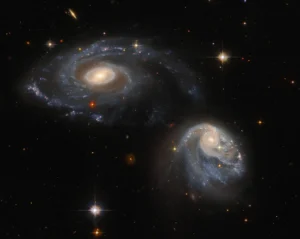
During these interactions, a small number of stars may get lost and end up outside of their original galaxy. These wandering stars can become part of intergalactic space, drifting freely between galaxies. However, it is important to note that the number of stars that end up outside of galaxies is relatively small compared to the total number of stars in the universe.
When galaxies merge, their gravitational forces cause immense disturbances in the gas and dust present within them. This disruption triggers the formation of new stars as the gas and dust collapse under the force of gravity. These newly formed stars can be observed in the merged galaxy, often leading to a burst of star formation.
Additionally, the interaction between galaxies can also result in the creation of supermassive black holes. When two galaxies merge, their central black holes are brought closer together. As they approach each other, the gravitational forces between them become stronger, causing them to eventually merge into a single, more massive black hole.
Furthermore, the tidal forces during galaxy interactions can stretch and distort the shape of the galaxies involved. This can lead to the formation of tidal tails, which are long streams of stars and gas that extend from the interacting galaxies. These tidal tails are a visible manifestation of the gravitational forces at play during the interaction.
Overall, the interactions between galaxies play a crucial role in shaping the universe as we know it. They drive the formation of new stars, the growth of black holes, and the creation of tidal features. By studying these interactions, scientists can gain valuable insights into the evolution and dynamics of galaxies, as well as the larger-scale structure of the universe.
Moreover, the presence of galaxies also influences the distribution and abundance of heavy elements in the universe. When stars reach the end of their lives, they undergo supernova explosions, releasing large amounts of heavy elements into their surroundings. These elements, such as carbon, oxygen, and iron, are essential building blocks for the formation of new stars and planetary systems.
Within galaxies, these heavy elements are recycled and redistributed through processes like stellar winds and supernova remnants. This enrichment of heavy elements in galactic environments enhances the likelihood of star formation by providing the necessary ingredients for the formation of planets and other celestial bodies.
On the other hand, outside of galaxies, the scarcity of heavy elements poses a challenge for star formation. The low density of gas and the lack of enrichment with heavy elements make it difficult for protostellar clouds to condense and collapse under gravity. As a result, the formation of stars outside of galaxies becomes even more improbable.
It is worth noting that while stars are primarily found within galaxies, there are some exceptional cases where stars have been observed in intergalactic space. These stars are believed to have been ejected from their parent galaxies through gravitational interactions or galactic mergers. However, such occurrences are relatively rare and do not significantly alter the overall distribution of stars in the universe.
In conclusion, the rarity of stars outside of galaxies can be attributed to several factors. The low density of gas, the absence of a stable gravitational field, and the scarcity of heavy elements all contribute to the challenging conditions for star formation in intergalactic space. Galaxies provide the ideal environment for stars to form and thrive, offering the necessary resources and interactions to sustain their existence. While there are exceptions to this rule, the vast majority of stars are found within galaxies, shaping the structure and dynamics of the universe as we know it.
One of the most fascinating aspects of galaxies is their immense size. Galaxies can range in size from a few thousand light-years across to hundreds of thousands of light-years. The Milky Way, our own galaxy, is estimated to be about 100,000 light-years in diameter. To put that into perspective, if we were to travel at the speed of light, it would take us 100,000 years to traverse the entire galaxy.
Within these vast galaxies, there are billions, if not trillions, of stars. Each star has its own unique characteristics, such as size, temperature, and brightness. Some stars are massive and burn brightly for a short period of time before exploding in a spectacular supernova, while others are smaller and have much longer lifespans.
But galaxies are not just made up of stars. They also contain other celestial objects, such as nebulae, which are vast clouds of gas and dust where new stars are born. These nebulae can be incredibly beautiful, with vibrant colors and intricate patterns. They are the cosmic nurseries where the building blocks of life are formed.
In addition to stars and nebulae, galaxies also harbor supermassive black holes at their centers. These black holes have masses millions or even billions of times that of our sun. They are incredibly dense and have gravitational forces so strong that not even light can escape their grasp. As matter is pulled into these black holes, it forms an accretion disk, which emits powerful jets of energy and radiation.
Understanding the formation and evolution of galaxies is a complex task that requires the collaboration of astronomers, physicists, and cosmologists. Through the use of powerful telescopes and advanced computer simulations, scientists are able to study galaxies in great detail, unraveling the mysteries of their origins and unraveling the secrets of the universe itself.