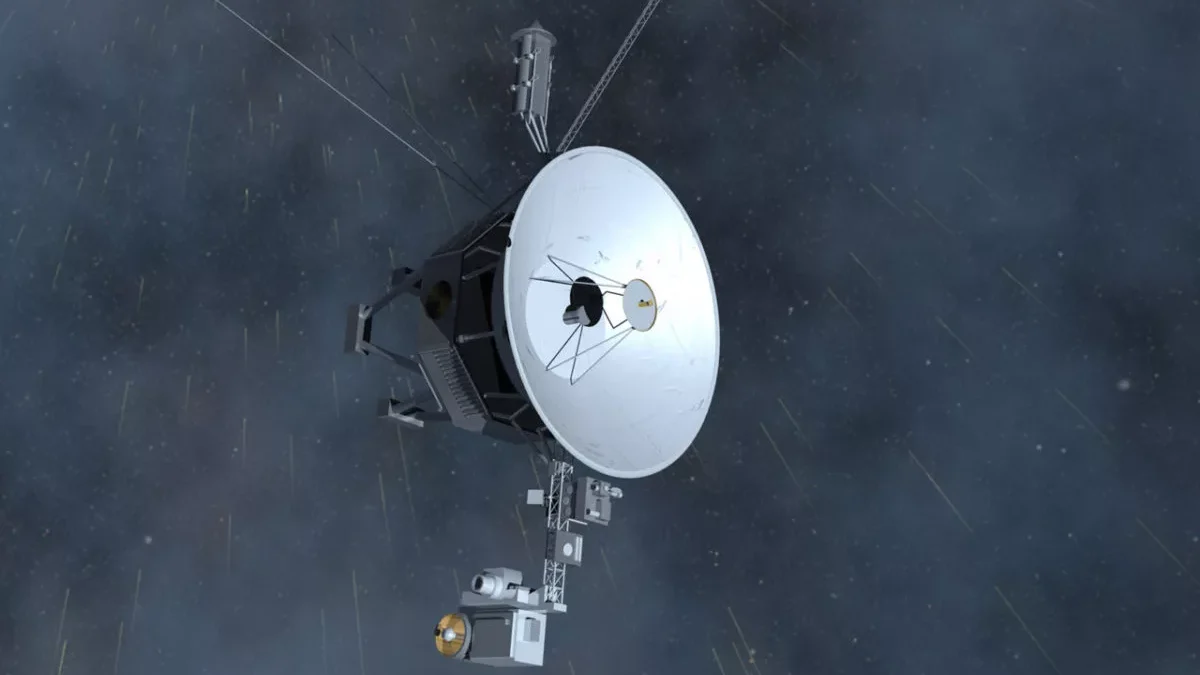

Voyager 1 is a space probe that launched on September 5, 1977. The National Aeronautics and Space Administration (NASA) launched Voyager 1; its primary objective was to explore areas particularly far from Earth. NASA expected Voyager 1 to explore the outer solar system, the outer area of the Milky Way, in which the four giant planets, Jupiter, Saturn, Uranus, and Neptune, can be found. Voyager 1 was also expected to explore interstellar space. Interstellar space is an area out of reach of the Sun’s influence that does not contain stars.
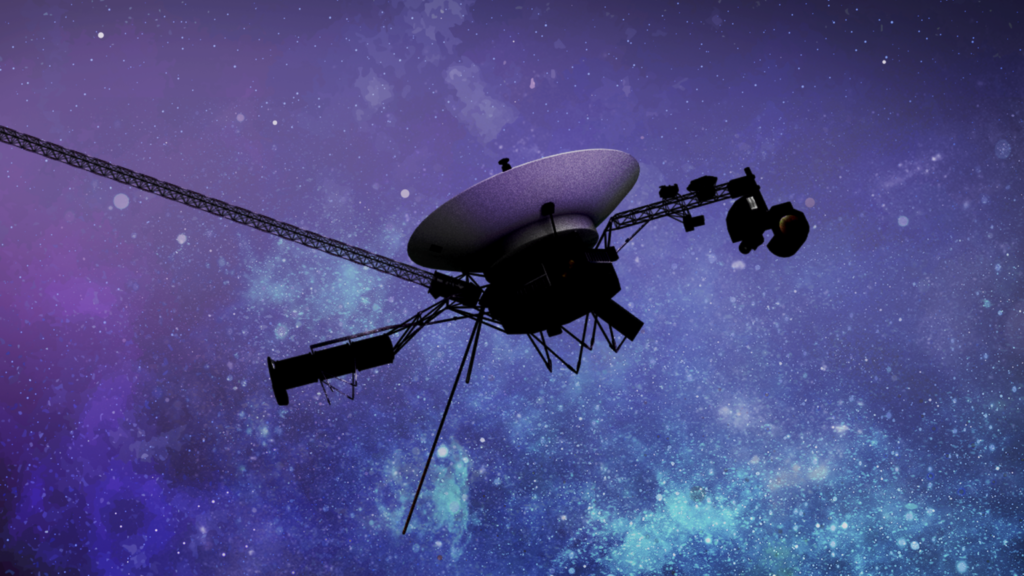
Voyager 1 was part of a twin-spacecraft mission with Voyager 2. The twin-spacecraft mission took advantage of a rare orbital positioning of Jupiter, Saturn, Uranus, and Neptune that permitted a multiplanet tour with relatively low fuel requirements and flight time. The alignment allowed each spacecraft, following a particular trajectory, to use its fall into a planet’s gravitational field to increase its velocity and alter its direction enough to fling it to its next destination. Voyager 2 was launched first, on August 20, 1977; Voyager 1 followed some two weeks later, on September 5. Using this gravity-assist, or slingshot, technique, Voyager 1 swung by Jupiter on March 5, 1979, and then headed for Saturn, which it reached on November 12, 1980. It then adopted a trajectory to take it out of the solar system. (Voyager 2 went on to visit Uranus and Neptune after its visits to Jupiter and Saturn.)
Voyager Mission
- Voyager 1 and Voyager 2 launched in 1977 and made a grand tour of the solar system’s outer planets.
- They are the only functioning spacecraft in interstellar space, and they are still sending back measurements of the interstellar medium.
- Each spacecraft carries a copy of the golden record, a missive from Earth to any alien lifeforms that may find the probes in the future.
Voyager 1 was designed to explore the solar system’s outer areas and interstellar space. Among its missions in the outer solar system, Voyager 1 was to photograph and study two giant planets, Jupiter and Saturn. The purpose of these missions was:
- Jupiter: Voyager 1 was to conduct a close flyby of the gas giant Jupiter, taking detailed measurements of the planet’s atmosphere, magnetic field, and moons. The space probe flew by Jupiter in In March 1979.
- Saturn: Voyager 1 was to conduct a close flyby of Saturn, taking detailed measurements of the planet’s atmosphere, magnetic field, Saturn’s rings, and moons. This flyby took place In November 1980.
- Interstellar Travel: After completing its primary mission to study the outer planets, Voyager 1’s mission was extended to include Voyager 1’s Interstellar Mission (VIM). In August 2012, the spacecraft crossed into the interstellar medium, becoming the first human-made object to enter interstellar space. Voyager 1 still travels through interstellar space, sending back data about the conditions and environment found there.
Since its launch, Voyager 1 has hit several significant milestones. These are listed in the following table.